Choose the size of your custom vinyl banners by measuring the usable display area, checking where people will read the message, and testing the artwork at that distance. The right dimensions must also leave room for installation; a banner that fills every inch of the available space can be difficult to mount.
- Size custom vinyl banners around the usable display area, viewing distance, and main message—not the artwork file alone.
- LongHorn Print offers custom vinyl banners with no minimum order and same-day quotes, not guaranteed same-day printing.
- Measure width and height separately, then confirm orientation, mounting clearance, and artwork requirements before ordering.
- Choose landscape for wide spaces, portrait for narrow spaces, and simplify any message that needs smaller text to fit.
How do you choose the size of your custom vinyl banner?
Start with the location, then work toward the artwork. Do not choose dimensions simply because an existing design already uses them. For your 2026 order, use this sequence before approving the finished size:
- Measure the space. Record the usable width and height of the wall, fence, booth, or other intended display area.
- Check the mounting. Identify the attachment points and any clearance the installation needs.
- Check the view. Stand where customers or guests will first need to read the banner.
- Set the message. Choose the main headline, then decide which supporting details belong underneath it.
- Confirm the order. Send the dimensions, orientation, quantity, artwork, and intended use together.
LongHorn Print is best for buyers who want custom vinyl banners with no minimum order and same-day quotes. A quote is not a production or delivery commitment; confirm those details separately before scheduling installation.
Why this matters
A banner has to fit both a physical space and a reading task. A design can fit neatly on a screen yet become difficult to read when displayed across a parking area or behind an event table.
Size also affects what you can reasonably include. If your banner only works when every detail receives equal attention, revise the message before increasing the dimensions. Make the main purpose readable first; supporting information comes second.
For a Houston storefront, check the actual mounting location rather than relying on a photo. For an event elsewhere in the US, request the organizer’s display measurements and restrictions before placing your 2026 order.
Measure the usable area, not just the surface
Start by identifying the boundaries your banner must stay within. Doors, windows, existing signs, fixtures, and neighboring displays can reduce the space available for a readable design.
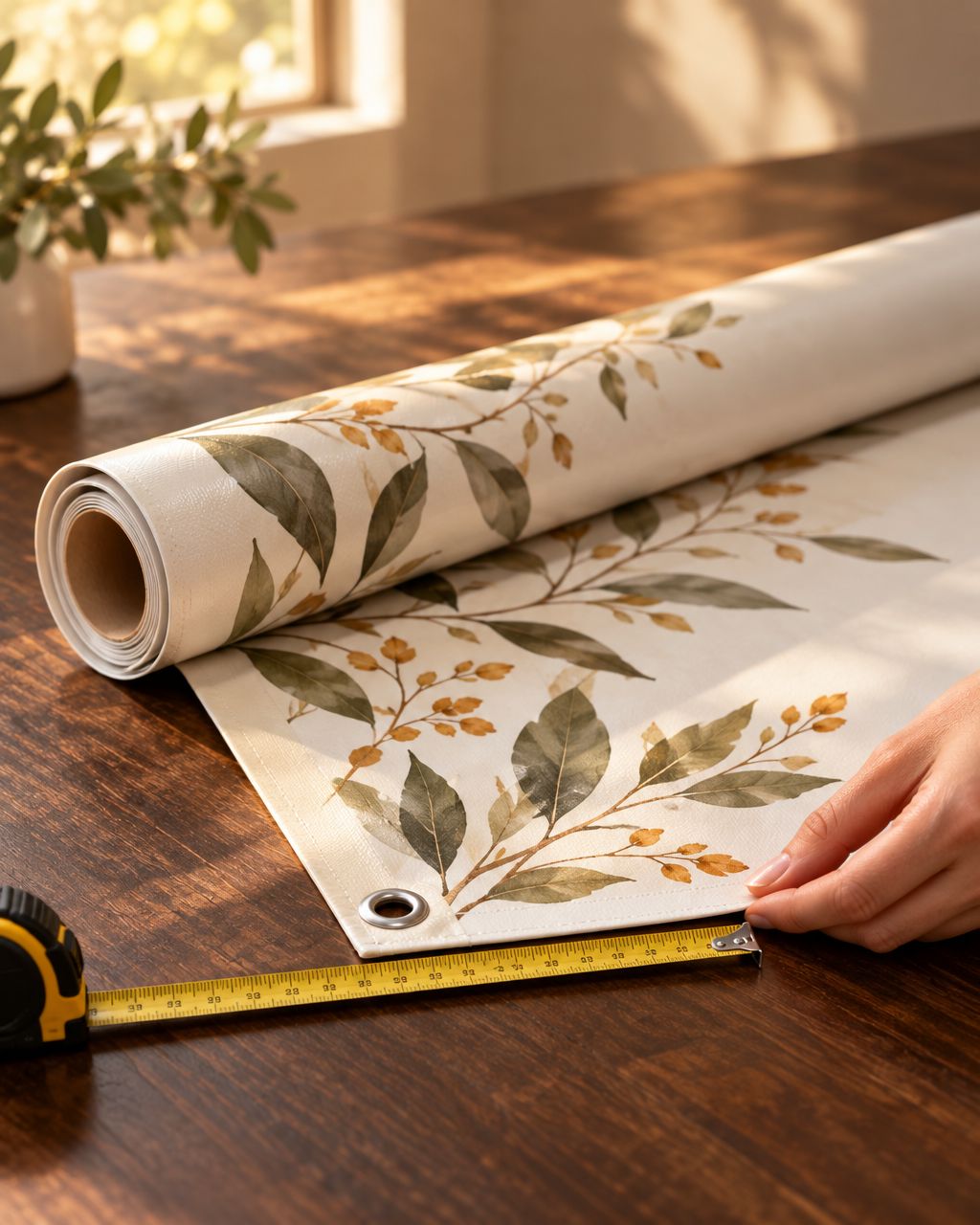
Measure width horizontally and height vertically. Record both with units, and state them in that order throughout the order conversation. A width-and-height label is clearer than a pair of unexplained numbers.
Use this measurement checklist:
- Display area: Measure the full surface where the banner will hang.
- Obstructions: Mark anything that covers the banner or blocks the message.
- Attachment points: Record where the banner can actually be secured.
- Clearance: Identify space needed around the edges for the planned installation.
- Finished size: Confirm the dimensions of the banner itself, not just the surrounding space.
Keep measurement units consistent. 1 foot equals 12 inches, and 1 yard equals 36 inches. Convert your measurements before submitting them rather than mixing feet and inches without clear labels.
Do not subtract an assumed mounting allowance. The clearance needed depends on the attachment method and location, so describe the setup and ask what finished dimensions suit it. A measurement plus a clear installation description is more useful than a guessed adjustment.
Check the viewing position before adding more content
The useful question is not simply whether the banner fits. Ask whether the intended reader can identify the main message from the place where that reader will encounter it.
Walk through the location as a customer would. At a storefront, that means checking the approach rather than standing directly against the wall. At an event, check the aisle and the view from behind neighboring displays.
Look for these problems:
- A table, vehicle, or fixture hides the lower portion.
- The headline competes with nearby signs.
- The banner faces away from the natural approach.
- The main message only becomes readable after someone has passed it.
- Supporting details require people to stop closer than the location allows.
Test the reading task, not just the design’s appearance. A banner intended to identify your business needs a clear name or category. An event-direction banner needs an obvious destination. Neither benefits from a crowded block of secondary information.
For a 2026 event order, repeat this check whenever the venue or display position changes. Reusing the same artwork does not mean the previous dimensions still fit the new location.
Choose landscape, portrait, or square dimensions
Orientation should follow the available space and the shape of your message. Compare the layouts before deciding which dimensions to request; no orientation is automatically the right choice for every banner.
| Orientation | Best for | Practical advantage | Trade-off to check |
|---|---|---|---|
| Landscape | Wide display areas and short horizontal headlines | Gives a headline room to run across the display | Requires enough usable horizontal space |
| Portrait | Narrow display areas and vertically arranged information | Uses height when horizontal room is limited | Long headlines need careful line breaks |
| Square | Balanced spaces and compact, centered messages | Keeps width and height equal | Can force a long headline into more lines |
Landscape: best for wide spaces
Choose landscape when the mounting area is wider than it is tall and the main message reads naturally across the space. Storefront openings, fences, and table-front displays are situations where you should assess this layout.
The limitation is horizontal room. Do not shrink a wide design until the text becomes hard to read just to make it fit a narrower location. Change the layout or shorten the wording instead.
Portrait: best for narrow spaces
Choose portrait when the usable display area is tall and narrow. Arrange the headline and supporting information in a clear reading order rather than squeezing an unchanged landscape design into the new shape.
The limitation is line length. A long business name or headline can create awkward breaks, so inspect the actual wording before committing to the dimensions.
Square: best for compact, centered messages
Choose square when equal width and height suit the installation area and the design has a compact message. A centered layout can give the headline a clear position without requiring a long horizontal line.
The limitation is flexibility for lengthy wording. If the design needs repeated reductions in text size, reconsider the copy or orientation rather than assuming a square banner must accommodate everything.
Why custom vinyl banner size varies
There is no single size that suits every location. These factors determine what you should request:
- Usable display space: Physical boundaries set the maximum area you can occupy.
- Viewing position: The reader’s location determines whether the message is useful at the intended distance.
- Message length: More wording takes space away from headline emphasis.
- Orientation: A wide headline and a vertically stacked layout need different proportions.
- Mounting setup: Attachment points and clearance affect the dimensions you can install.
- Venue requirements: An organizer or property manager can restrict the display area or installation method.
Separate fixed constraints from choices you can change. You cannot solve a narrow mounting area by requesting a wider banner, but you can change the headline, orientation, or placement.
Treat fit and readability as separate approval checks. Passing one does not guarantee the other.
Prepare artwork for the dimensions you actually order
Confirm the banner’s proportions before completing the design. Enlarging artwork does not correct an unsuitable layout, and stretching it changes the appearance of text and graphics.
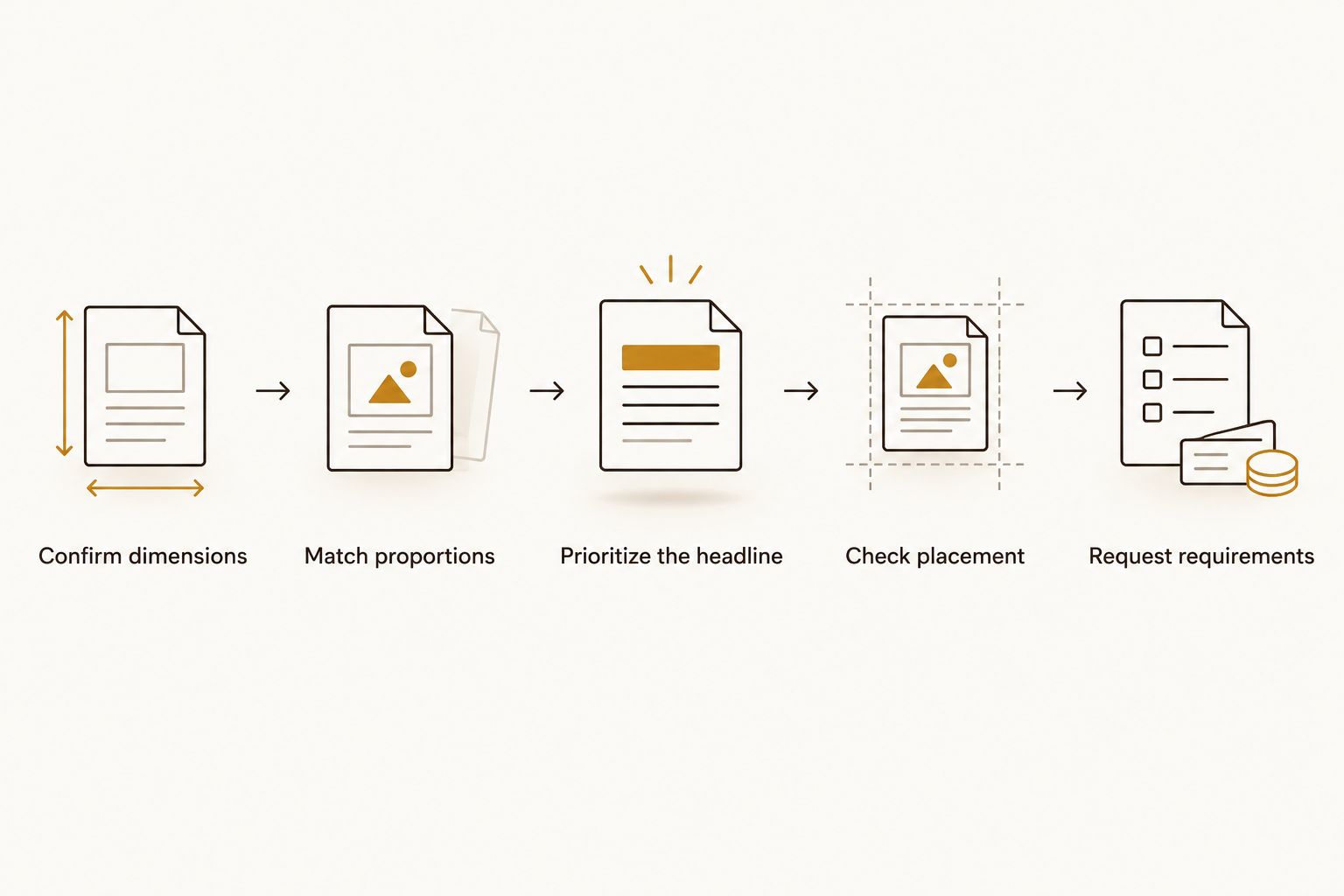
Use this preparation sequence:
- Confirm dimensions. Write down the intended finished width and height with units.
- Match proportions. Set the design to the same width-to-height relationship as the banner.
- Prioritize the headline. Make the main message the first thing a reader notices.
- Check placement. Keep essential content away from areas affected by the planned installation.
- Request requirements. Confirm accepted file formats, image quality requirements, and any finishing-related artwork instructions.
Do not assume a small preview proves the file is ready for a large print. Ask whether the supplied artwork suits the requested finished dimensions before approving production.
If your 2026 campaign uses an existing design, review every detail rather than only replacing the date. Confirm the location, wording, contact information, and any event-specific instructions. Then inspect line breaks again at the new proportions.
Send a quote request that answers the sizing questions
Give the printer enough context to assess the order without guessing. A dimension alone does not explain whether the banner will hang above a doorway, cover a table front, or attach to a fence.
Include the following in your request:
- Intended finished width and height, with units.
- Landscape, portrait, or square orientation.
- Quantity for each size and design.
- A description of the installation location and attachment plan.
- The artwork file or a clear description of what still needs preparing.
- The date you need the banner in hand, not only the event date.
- Whether the order is for a Houston-area project or US shipping.
LongHorn Print offers no-minimum ordering, so you can request a banner for an individual project without treating it as a bulk order. Same-day quotes help with planning, but production timing and delivery timing require separate confirmation.
A useful 2026 order note separates requirements from preferences. State the deadline you must meet, then identify any dimensions or layout choices you can adjust. Do not assume that submitting a request confirms the schedule.
Plan your custom banner order
Prepare your dimensions, quantity, artwork, and deadline before requesting a same-day quote.
Should I choose a bigger banner for easier reading?
Choose a bigger banner only when the location supports it and the extra space improves the message. Increasing dimensions will not fix weak contrast, excessive wording, or a mounting position that hides the headline.
Try shortening the message before enlarging the banner. If the headline still cannot do its job from the intended viewing position, reassess both the size and placement.
Can I reuse the same banner size for different locations?
Reuse a banner size only after checking each location’s usable area and viewing position. Matching event types do not guarantee matching display spaces.
If you are ordering for several locations, record dimensions and installation notes separately. Confirm which sites can share a layout and which need a different size before ordering the full quantity.
What if my artwork and banner have different proportions?
Revise the layout rather than stretching the artwork to fill the banner. Stretching changes the shape of text and graphics; cropping can remove information you intended to keep.
Ask how the file should be adapted before approving it. Moving supporting details or changing line breaks is a layout decision, not simply an enlargement setting.
FAQ
What size should I order for custom vinyl banners?
Order custom vinyl banners to fit the usable display area and make the main message readable from the intended viewing position. Measure width and height, check mounting clearance, and confirm the layout before ordering.
Should I list banner width or height first?
List width first and height second, and label both measurements with units. Explicit labels prevent confusion when a design is changed between landscape and portrait.
Is a landscape banner better than a portrait banner?
A landscape banner is better for a wide space and a horizontal headline; a portrait banner suits a narrow, vertical space. Choose the orientation that fits both the location and the wording.
Can I order just one custom vinyl banner from LongHorn Print?
LongHorn Print offers custom vinyl banners with no minimum order. Include the finished dimensions, artwork, intended use, and required date when requesting a quote.
Does a same-day quote mean my banner will be printed that day?
A same-day quote does not mean same-day printing or delivery. Confirm production timing and your required in-hand date separately before approving the order.
Can I enlarge a small artwork file for a banner?
Enlarging a small artwork file does not guarantee suitable print quality. Confirm that the file meets the printer’s requirements at the intended finished dimensions before production.
What should I check before ordering a banner for an event?
Check the event’s display dimensions, mounting restrictions, and the location where attendees will read the banner. Send the required in-hand date with your quote request rather than relying on the event date alone.
One last thing
A printed headline mockup can reveal a sizing problem before you order the full banner. You do not need to reproduce the entire design: use paper to check the intended headline size and view it from the planned reading position, with the property or venue’s permission.
If you cannot read the main message comfortably, revise the wording, layout, size, or position before approval. That check tests what matters: whether the person passing your banner understands it.